
The Performance Marketing Playbook for Podcast Advertising: Strategy, Formats, and ROI


Key Takeaways
- High Attention: Podcast listeners are twice as attentive to ads compared to digital video viewers.
- Proven ROI: Podcast advertising generates a long-term Return on Ad Spend (ROAS) of 4.9x, outperforming the average media ROAS of 3.7x.
- Action-Oriented: 95% of weekly U.S. listeners have taken tangible action (like visiting a website) after hearing a podcast ad.
- Measurement: Modern pixel-based attribution allows marketers to track conversions and site visits precisely, moving beyond simple promo codes.
Why Podcast Advertising is a Performance Channel
Historically viewed as a brand-building medium, podcasting has evolved into a full-funnel performance engine. With the industry track to hit over $4 billion in the US by 2025, marketers are increasingly leveraging the medium for scalable, measurable growth.
Do podcast ads capture attention?
Yes. In an era of second screens and endless scrolling, podcasts command high engagement. Research shows that 64% of people give podcasts their full attention, compared to just 49% for music streaming and 44% for radio.
Furthermore, this attention extends to the ads themselves. 44% of listeners pay more attention to podcast ads than ads they see or hear elsewhere.
How does podcast ROAS compare to other channels?
Podcasts consistently outperform mainstream digital channels in delivering profitable returns. According to a study by Acast and OMD’s Annalect:
- Long-term ROAS: Podcasts generated a 4.9x return, significantly higher than the media average of 3.7x.
- Short-term ROAS: Podcast ads delivered a 4.2x return, surpassing social media (3.6x) and radio (3.5x).
- Conversion Rate: 6.2% of website visits driven by podcast ads convert into purchases.
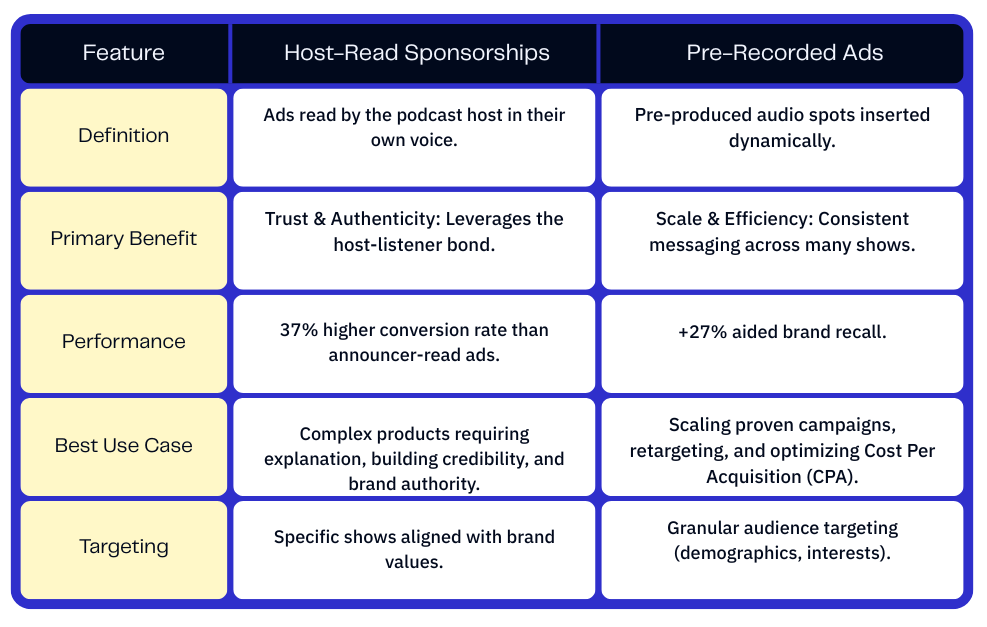
Ad Formats: Sponsorships vs. Pre-Recorded Ads
Choosing the right ad format is critical for campaign success. A balanced approach often works best, leveraging the strengths of both formats.
Measurement: How to Track Podcast Performance
The biggest myth in podcast advertising is that it cannot be measured. Modern tools allow podcasts to go "toe-to-toe" with other performance channels.
1. Pixel-Based Attribution
This is the gold standard for performance tracking. A small piece of code (pixel) placed on your website matches listeners who heard an ad to visitors on your site using IP tracking.
- Why it works: It tracks the complete user journey (visits and purchases) even if the listener never clicks an ad or uses a code.
- Availability: Platforms like Acast provide free access to partners like Podscribe to democratize precise measurement.
2. Vanity URLs
Hosts read a simple, memorable URL (e.g., yourbrand.com/podcast). This allows you to track visitors precisely using UTM parameters.
3. Promo Codes
Providing listeners with unique discount codes helps attribute conversions directly to specific campaigns or shows.
4. Post-Purchase Surveys
Including "How did you hear about us?" in checkout surveys captures attribution data from customers who may have bypassed digital tracking.
Strategy: The Test-and-Scale Framework
To optimize for performance, Acast recommends a three-step framework similar to the scientific method.
Phase 1: Test and Learn (Discovery)
- Goal: Gather baseline data to identify performance signals.
- Tactic: Cast a wide net. Test a mix of sponsorships (niche, mid-size, and big-name shows) and pre-recorded ads.
- Targeting: Experiment with different demographics, categories, and audience attributes.
Phase 2: Analyze and Optimize
- Goal: Reallocate budget toward winning tactics.
- Frequency: Review performance every four weeks using pixel attribution data.
- Metrics: Focus on Visitor Rate, Cost Per Acquisition (CPA), and ROAS.
- Action: "Double down" on top-performing shows by increasing budget, and pause shows that miss KPI targets.
Phase 3: Build Core Strategy (Scale)
- Goal: Establish a sustainable, always-on growth strategy.
- Tactic: Renew best-performing shows into long-term campaigns.
- Expansion: Use planning tools to identify new shows with audiences similar to your successful tests. Keep a flexible budget for continuous testing of new creatives and podcasts.
Frequently Asked Questions (FAQ)
What is the average conversion rate for podcast ads?
According to Podscribe data, podcast ads lead to site visits from 0.24% of impressions. Conversion rates from impressions are roughly 0.016% for event-based campaigns and 0.13% for app installs.
How do I target the right audience in podcasts?
You can target audiences based on:
- Demographics: Age, gender, and location.
- Context: Specific genres (e.g., News, Sports) or specific shows.
- Behaviors: First- and third-party data segments like "Premium Shoppers" or "Affluent Households".
Do people skip podcast ads?
Skipping is lower than often assumed. Podcast listeners complete ads more regularly than audiences on radio, streaming TV, TikTok, or YouTube. This is partly because the "lean-in" nature of podcasting makes ads feel like part of the show rather than an interruption.
Next Steps for Marketers
Ready to launch a performance campaign?
- Define your goal: Are you optimizing for CPA, ROAS, or site visits?.
- Install your pixel: Ensure attribution is active from day one.
- Start broad: Test both sponsorships and pre-recorded ads to gather baseline data.
Key Takeaways
- High Attention: Podcast listeners are twice as attentive to ads compared to digital video viewers.
- Proven ROI: Podcast advertising generates a long-term Return on Ad Spend (ROAS) of 4.9x, outperforming the average media ROAS of 3.7x.
- Action-Oriented: 95% of weekly U.S. listeners have taken tangible action (like visiting a website) after hearing a podcast ad.
- Measurement: Modern pixel-based attribution allows marketers to track conversions and site visits precisely, moving beyond simple promo codes.
Why Podcast Advertising is a Performance Channel
Historically viewed as a brand-building medium, podcasting has evolved into a full-funnel performance engine. With the industry track to hit over $4 billion in the US by 2025, marketers are increasingly leveraging the medium for scalable, measurable growth.
Do podcast ads capture attention?
Yes. In an era of second screens and endless scrolling, podcasts command high engagement. Research shows that 64% of people give podcasts their full attention, compared to just 49% for music streaming and 44% for radio.
Furthermore, this attention extends to the ads themselves. 44% of listeners pay more attention to podcast ads than ads they see or hear elsewhere.
How does podcast ROAS compare to other channels?
Podcasts consistently outperform mainstream digital channels in delivering profitable returns. According to a study by Acast and OMD’s Annalect:
- Long-term ROAS: Podcasts generated a 4.9x return, significantly higher than the media average of 3.7x.
- Short-term ROAS: Podcast ads delivered a 4.2x return, surpassing social media (3.6x) and radio (3.5x).
- Conversion Rate: 6.2% of website visits driven by podcast ads convert into purchases.
Ad Formats: Sponsorships vs. Pre-Recorded Ads
Choosing the right ad format is critical for campaign success. A balanced approach often works best, leveraging the strengths of both formats.
Measurement: How to Track Podcast Performance
The biggest myth in podcast advertising is that it cannot be measured. Modern tools allow podcasts to go "toe-to-toe" with other performance channels.
1. Pixel-Based Attribution
This is the gold standard for performance tracking. A small piece of code (pixel) placed on your website matches listeners who heard an ad to visitors on your site using IP tracking.
- Why it works: It tracks the complete user journey (visits and purchases) even if the listener never clicks an ad or uses a code.
- Availability: Platforms like Acast provide free access to partners like Podscribe to democratize precise measurement.
2. Vanity URLs
Hosts read a simple, memorable URL (e.g., yourbrand.com/podcast). This allows you to track visitors precisely using UTM parameters.
3. Promo Codes
Providing listeners with unique discount codes helps attribute conversions directly to specific campaigns or shows.
4. Post-Purchase Surveys
Including "How did you hear about us?" in checkout surveys captures attribution data from customers who may have bypassed digital tracking.
Strategy: The Test-and-Scale Framework
To optimize for performance, Acast recommends a three-step framework similar to the scientific method.
Phase 1: Test and Learn (Discovery)
- Goal: Gather baseline data to identify performance signals.
- Tactic: Cast a wide net. Test a mix of sponsorships (niche, mid-size, and big-name shows) and pre-recorded ads.
- Targeting: Experiment with different demographics, categories, and audience attributes.
Phase 2: Analyze and Optimize
- Goal: Reallocate budget toward winning tactics.
- Frequency: Review performance every four weeks using pixel attribution data.
- Metrics: Focus on Visitor Rate, Cost Per Acquisition (CPA), and ROAS.
- Action: "Double down" on top-performing shows by increasing budget, and pause shows that miss KPI targets.
Phase 3: Build Core Strategy (Scale)
- Goal: Establish a sustainable, always-on growth strategy.
- Tactic: Renew best-performing shows into long-term campaigns.
- Expansion: Use planning tools to identify new shows with audiences similar to your successful tests. Keep a flexible budget for continuous testing of new creatives and podcasts.
Frequently Asked Questions (FAQ)
What is the average conversion rate for podcast ads?
According to Podscribe data, podcast ads lead to site visits from 0.24% of impressions. Conversion rates from impressions are roughly 0.016% for event-based campaigns and 0.13% for app installs.
How do I target the right audience in podcasts?
You can target audiences based on:
- Demographics: Age, gender, and location.
- Context: Specific genres (e.g., News, Sports) or specific shows.
- Behaviors: First- and third-party data segments like "Premium Shoppers" or "Affluent Households".
Do people skip podcast ads?
Skipping is lower than often assumed. Podcast listeners complete ads more regularly than audiences on radio, streaming TV, TikTok, or YouTube. This is partly because the "lean-in" nature of podcasting makes ads feel like part of the show rather than an interruption.
Next Steps for Marketers
Ready to launch a performance campaign?
- Define your goal: Are you optimizing for CPA, ROAS, or site visits?.
- Install your pixel: Ensure attribution is active from day one.
- Start broad: Test both sponsorships and pre-recorded ads to gather baseline data.


